What Makes UGC Feel Authentic (And What Kills It Instantly)
The small signals that make a viewer trust a video, and the production choices that break the spell in under a second.
Summary — the short answer
- Viewers judge authenticity in under a second from framing, room and delivery — not from production value.
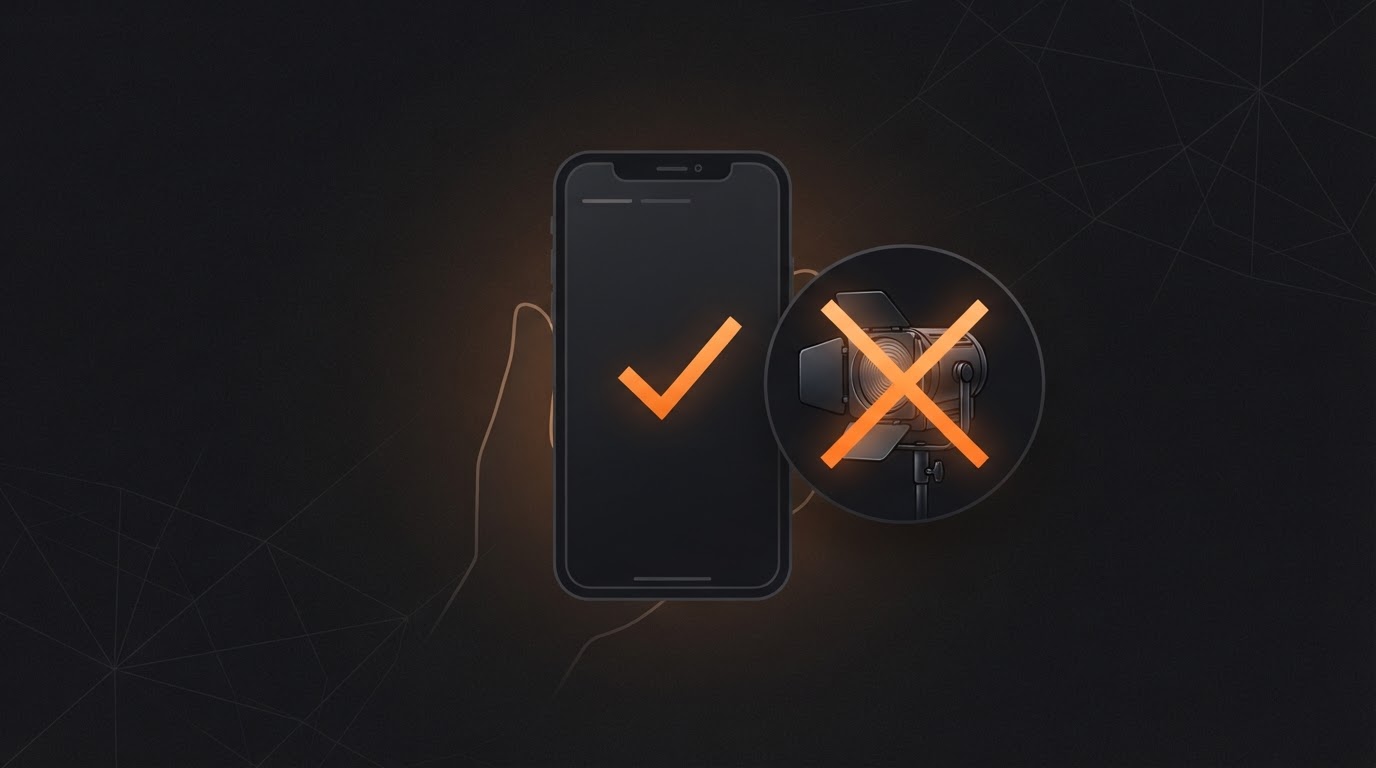
- Handheld movement, a real room and one natural stumble build trust; studio lighting and rehearsed delivery destroy it.
- Show the product inside the first four seconds or viewers file the video as entertainment and never register the brand.
- Polish and believability are frequently opposites in UGC.
- Disclose paid partnerships clearly — in India, ASCI guidelines require it and audiences punish hidden ads.
Key facts
- Trust decision window
- Under 1 second
- Product on screen by
- 4 seconds
- Best framing
- Handheld, arm's length
- Lighting
- Practical — window or lamp
- Disclosure
- Required for paid content in India
UGC works because it does not read as advertising. A viewer scans framing, room and delivery in a fraction of a second and decides whether a real person is talking about a real experience. Every production decision you make either protects that read or breaks it — and the expensive decisions are usually the ones that break it.
The signals that build trust
- Handheld framing with slight natural movement, rather than a locked-off tripod shot.
- A real room with evidence of life in it — a shelf, a plant, laundry, a cluttered desk.
- One natural pause, stumble or self-correction left in the edit.
- Direct eye contact at a slightly-too-close phone distance, the way people actually hold a phone.
- Practical light: a window, a lamp, a doorway. Anything that looks like light that was already in the room.
- Speech that code-mixes the way the creator normally speaks, rather than clean single-language delivery.
The signals that break it instantly
- Studio lighting with no shadow anywhere on the face.
- A voice that sounds read rather than spoken — the giveaway is uniform pacing.
- Perfect grammar in a language the creator would normally code-mix.
- A product held at a catalogue angle instead of a used-it-this-morning angle.
- Cuts landing exactly on the beat of stock music, which signals an editor rather than a person.
- A hook that names the brand before it names a problem.
Polish is not the goal. Believability is. In UGC they are frequently opposites.
The four-second product rule
If the product is not visible in the first four seconds, most viewers categorise the video as entertainment and never encode the brand. They will remember the story and not what it was selling, which is the most expensive possible outcome for a paid UGC asset.
This does not mean opening with a product shot. It means the product should be in frame — held, used, on the table — while the hook is doing its work. The viewer should be able to answer "what is this about" without you having said it.
Scripting for authenticity
- 1Write the value beat as a specific, checkable claim rather than a benefit adjective.
- 2Write the problem beat in the viewer's own words, ideally lifted from real comments or reviews.
- 3Write the hook as personal experience rather than product description.
- 4Leave one sentence deliberately unpolished, and do not fix it in the edit.
- 5Read the whole thing aloud once. If any line would embarrass you to say to a friend, rewrite it.
Where generated UGC fits
Generated creator videos are extremely good at testing a message cheaply. You can put the same script in five different mouths, in three languages, and find out which framing actually converts before committing a shoot budget.
What they do not replace is genuine physical demonstration — texture, fit, a real before and after. Use generation to find the winning message, then spend the shoot budget on the message that already won.
A quick authenticity audit
| Check | Pass | Fail |
|---|---|---|
| Framing | Slight handheld drift | Perfectly static |
| Background | Real, slightly untidy | Seamless backdrop |
| Audio | Room tone present | Studio-dry voice |
| Delivery | One stumble kept | Uniform pacing |
| Product | In hand by 4s | Revealed at the end |
| Language | Natural code-mixing | Formal single language |
Frequently asked questions
Does higher video quality hurt UGC performance?
Not quality itself — sharpness and clean audio help. What hurts is the visual language of advertising: perfect lighting, static framing and rehearsed delivery.
Should UGC be shot vertically only?
Shoot 9:16 and keep the action inside the centre square so you can crop to 1:1 or 16:9 later. You can crop down, never up.
How many UGC variations should a brand test?
Start with four to six that differ in one variable — usually the hook. Scale spend only on what wins on a real conversion metric.
Do generated creators need to be disclosed as AI?
Best practice is yes, clearly, particularly for testimonial-style claims. Presenting a generated presenter as a real customer is misleading and increasingly regulated.
Sources and further reading
- ASCI influencer advertising guidelinesThe Indian standard for disclosure and claim substantiation in creator content.
- Meta Business — creative best practicesPlatform guidance on ad creative, framing and safe zones.
- VerbCraft: create UGC ads without hiring actorsThe production workflow and variation matrix.
- VerbCraft: UGC video pricing in IndiaWhat this work is worth when a brand is paying for it.
Use this article elsewhere
Copy a structured brief for ChatGPT, Claude, Perplexity or Gemini — it includes the key points and the canonical link so the assistant can cite VerbCraft properly.
https://verbcrafts.in/blog/what-makes-ugc-feel-authentic