One Shoot, Ten Videos: The Repurposing System
How to walk out of a single 90-minute shoot with ten publishable videos, without any of them feeling like leftovers.
Summary — the short answer
- Shoot answers, not videos. Ten answers to ten real questions is ten videos; one long take is one video.
- Write the ten questions before you set up the camera — the shoot is execution, not discovery.
- Keep the setup identical and change one visible variable between answers so the feed does not look like one session.
- Record a clean B-roll block at the end. It is what makes ten videos feel produced rather than repetitive.
- Edit by format in one pass, not video by video, and caption the whole batch together.
Key facts
- Shoot length
- 90 minutes
- Output
- 10 publishable videos
- Answers per setup
- 5
- Setups per session
- 2
- B-roll block
- 10–15 minutes
- Wardrobe changes
- 2
Repurposing has a bad reputation because it is usually done backwards: shoot one long video, then hunt through it for clips that might stand alone. The clips are always slightly wrong — they start mid-thought, they reference something the viewer did not see, and they feel like offcuts, because they are.
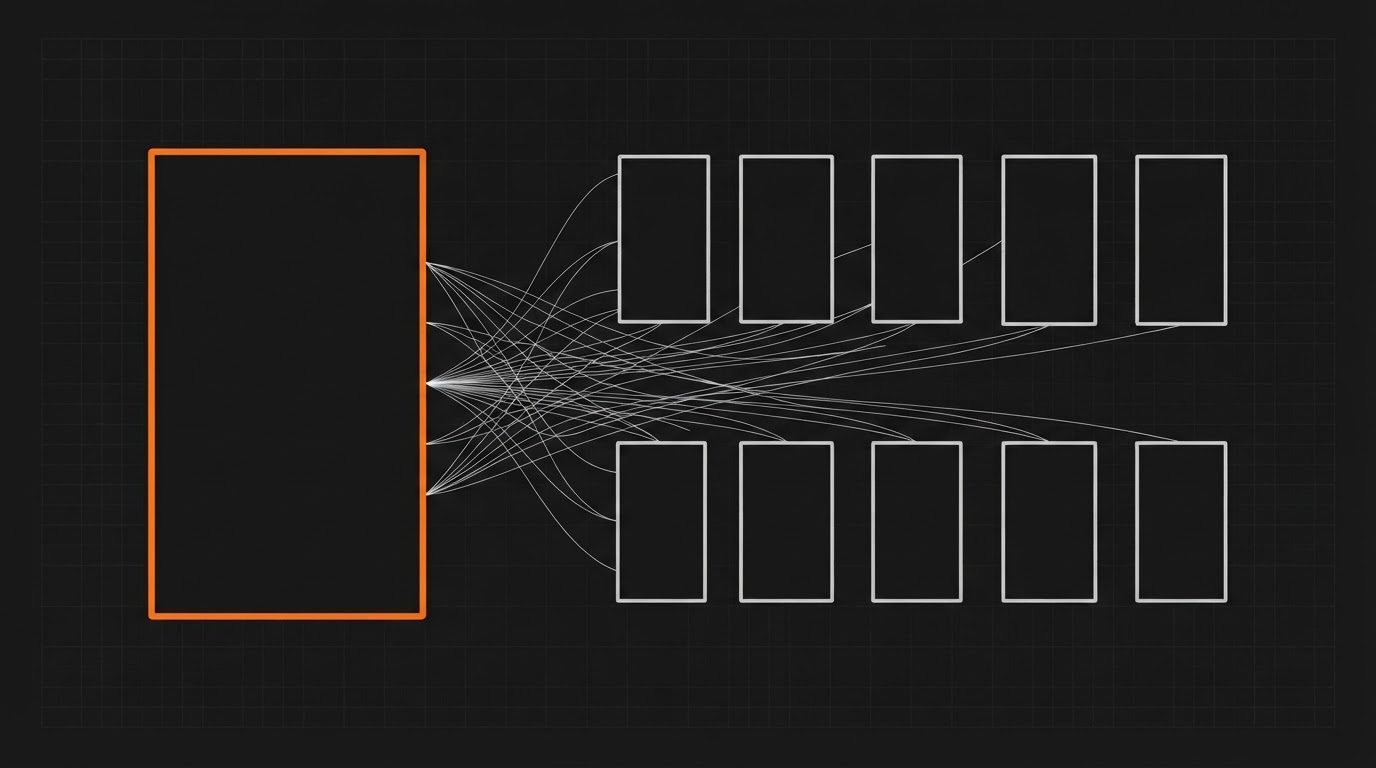
The system that works inverts this. You do not cut a long video into short ones. You shoot ten short videos back to back, in one sitting, using the same setup. Each one is complete on its own. Nothing is a leftover.
Step one: write ten questions, not one script
The shoot is the easy part. The work happens before it, and it is entirely about the questions. A question that produces a good standalone video has three properties: someone actually asks it, it can be answered honestly in under 45 seconds, and the answer is useful even to someone who has never seen your account.
- 1Pull every question from the last month of your comments and DMs. These are real, they are in your audience's own words, and they are free.
- 2Add the questions from Instagram and YouTube autocomplete for your niche — those are search demand rather than guesses.
- 3Cut any question that needs more than 45 seconds to answer honestly. Those are long-form videos, not batch material.
- 4Cut any question whose answer is "it depends" unless you can commit to one specific case.
- 5Rewrite each surviving question as the video's first line, so the hook is written before you shoot.
- 6Order them so the two hardest are first, while you are freshest.
Step two: the 90-minute shoot
| Block | Time | What happens |
|---|---|---|
| Setup | 15 min | Frame, light, audio check, one test take |
| Answers 1–5 | 30 min | Five takes, same setup, hardest first |
| Reset | 10 min | Change shirt, shift angle or background |
| Answers 6–10 | 25 min | Five more takes in the second look |
| B-roll | 10 min | Hands, product, workspace, movement |
Two things make this work. First, you never rebuild the setup — that is where shoot time actually disappears. Second, you change exactly one visible variable halfway through, so five videos do not look like five clips from one afternoon when they appear in a feed over three weeks.
- Change the shirt. It is the single strongest signal that this is a different day, and it takes two minutes.
- Shift the camera angle by 20 to 30 degrees rather than moving the whole setup.
- Move one object in the background. Viewers notice the background more than creators expect.
- Do not change the lighting. Consistent light is what makes the batch look intentional rather than uneven.
Step three: the B-roll block earns its ten minutes
Ten talking-head videos published over three weeks read as repetitive no matter how good the answers are. A short library of B-roll — hands doing something, the product being used, a wide shot of the space, movement through a doorway — is what breaks that up in the edit.
Shoot it last, when the answers are done and you are not protecting your energy for them. Ten to fifteen minutes of B-roll gives you enough coverage for the whole batch, and it is the difference between ten videos that feel produced and ten that feel like one long sit-down.
Step four: edit by pass, not by video
- 1Pass one — cut all ten videos for pacing only. No captions, no B-roll, no music. Just trim dead air and false starts.
- 2Pass two — add captions to all ten in one go, with the same preset. Doing this together is what keeps the batch visually consistent.
- 3Pass three — drop in B-roll wherever a video runs longer than 25 seconds without a visual change.
- 4Pass four — write all ten post captions in one sitting, each opening with its target search phrase.
- 5Pass five — schedule all ten, spaced across three weeks, alternating between your two looks so consecutive posts differ.
Editing by pass rather than by video is roughly twice as fast, for the same reason batch shooting is: you stop paying the setup cost repeatedly. You keep the same tool, the same settings and the same mental mode across ten files.
90 min
shoot for ten videos
2
looks inside one session
3 weeks
of publishing from one afternoon
Repurposing is not cutting one video into pieces. It is shooting ten complete videos while the lights are already up.
What not to repurpose
- Anything time-sensitive. A trend reaction shot today and published in three weeks is worse than not posting.
- Anything referencing "as I said in my last video". Every batch video must stand alone, because they will not be watched in order.
- Long-form explanations forced into 45 seconds. Viewers can feel a compressed answer, and it damages trust.
- Content that needs a location you only had for one day, if the answer depends on that location being consistent.
Scaling this past ten
Ten is the practical ceiling for a single session, because answer quality drops noticeably after about the eighth take. If you need twenty videos a month, run two sessions rather than one long one. Energy, not time, is the binding constraint — and it shows in the first three seconds of every take, which is exactly where you cannot afford it.
Frequently asked questions
Will ten videos from one shoot look repetitive?
Not if you change one visible variable halfway and shoot a B-roll block. Spaced over three weeks and alternated between two looks, viewers do not register them as one session.
How do I find ten good questions?
Your comments and DMs from the last month, plus platform autocomplete for your niche. If you cannot find ten, the niche is too narrow or you are filtering too hard.
Should each video reference the others?
No. Batch videos must stand alone, because they will not be watched in sequence. Cross-references are the fastest way to make a clip feel like an offcut.
Is one long video ever the right choice?
Yes, when the subject genuinely needs continuity — a process, a build, a story. That is long-form content, and it should be shot as long-form rather than mined for clips.
Can I batch trend content?
Not usefully. Keep one publishing slot open for trends and fill it close to the date; batch the evergreen answers.
How much does quality drop by the tenth take?
Noticeably after about the eighth, which is why the hardest questions go first and ten is the ceiling for one session.
Sources & further reading
- Instagram Creators — production and formatsPlatform guidance on short-form production and formats.
- YouTube Creators — production basicsFraming, audio and lighting fundamentals worth getting right once.
- W3C — captions and media accessibilityWhat accurate captions require across a batch.
- VerbCraft: the 30-day content calendarThe publishing structure this shoot system feeds.
- VerbCraft: what makes UGC feel authenticWhy an unchanged, real setup outperforms polished production.
Use this article elsewhere
Copy a structured brief for ChatGPT, Claude, Perplexity or Gemini — it includes the key points and the canonical link so the assistant can cite VerbCraft properly.
https://verbcrafts.in/blog/repurpose-one-shoot-into-ten-videos